Writing Tips        Vikings        Medieval History        Ancient Rome        Architecture        Old West        Travel        Vocabulary         

Western Word of the Week - Tanks - #WesternWordoftheWeek

Howdy!

Welcome to our Weekly Western Word of the Day...

Tanks - large dirt ponds to provide water for animals

Today you will often see large barrels that are called tanks.

Source:
Cowboy Lingo by Ramon F. Adams; ISBN#0-618-08349-9

Western Travel - Heritage Farmstead Museum (Part Five) - Plano, Texas - #TravelTuesday

Welcome to my weekly column #TravelTuesday featuring places I've discovered during my research trips or just wandering around in historical areas. I hope you enjoy my discoveries.

Last week we investigated the Farrell-Wilson formal parlor and the interesting pieces in there. Today we'll move to the next room, the informal family parlor.

Staged Family Parlor, photo from the Heritage Museum website

The room has been altered a little bit since this photo above was taken and now features a Depression-era family playing a board game, Monopoly. A Monopoly-type game called The Landlord's Game was invented by Elizabeth Magie in 1902 (patented in 1904). It evolved into what we know today by 1933, sold by Parker Brothers.


Just past the mannequin on a table in front of the window is an old-time radio.


Now we come to the fireplace which seems larger than the one in the formal parlor. Both feature wooden mantels, looking-glass mirrors, and colorful stone surrounds.


Here is a nice book cabinet with a modern-day interactive iPad in front of it. Notice the Holmes stereoscope viewing device on the top-right. These were popular after their invention in 1860 as they made pictures 3-dimensional.


An old photograph of the Wilsons (Ammie and Dudley).


Colored-glass electric chandelier.


A better view of the radio and an interesting red cushioned chair with an embroidered foot rest.


That's all for today. Next week we'll look at a few odds and ends in the downstairs hallway.

History of Monopoly - en.wikipedia.org/wiki/History_of_the_board_game_Monopoly

Learn more by checking out the official site - www.heritagefarmstead.org/

Heritage Farmstead Museum Physical Address: 1900 West 15th Street, Plano, Texas 75075 Phone Number: 972-881-0140 Hours: Tuesday-Sunday: 10am-4:30pm. Closed Mondays and major holidays. Admission: $3.00 per person (ages 3 and up) + $4 for tour of house

Photo Credit of Family Parlor - https://www.heritagefarmstead.org/plano-elegance-blackland-prairie-farmstead-1890-1925/family-parlor-223-2/

Historical Tidbit Thursdays - The Oregon Trail - The Journey - #TidbitThursday

Howdy!

Welcome to our newest addition to the blog - Historical Tidbit Thursdays!

The next few weeks I'm veering off my normal Texas History research trail to dive deep into the Oregon Trail and share my research with you! Hope you enjoy!

As we mentioned in the first post, the first group journey consisted of a 1000 people but only 120 wagons. That means a little over 8 people for every wagon. Each wagon had to be filled with enough food and supplies to last 6 months.

Only very young children, those who couldn't walk or ride, would sit in the wagon. Most walked. They averaged 12 to 15 miles of walking per day.

Children had their use along the journey - collecting firewood or buffalo chips for fires.

The emigrants (as they were called) faced blistering heat, snowstorms, raging rivers, accidents, wild animals, and contagious diseases (like cholera).

But the end of the journey was worth it - each adult male was granted 640 acres.

Source:
The Oregon Trail by Rachel Lynette; ISBN#978-1-4777-0786-9

Western Word of the Week - Rancho - #WesternWordoftheWeek

Howdy!

Welcome to our Weekly Western Word of the Day...

Rancho - another name for a ranch or a farm but one that focuses on animal or livestock raising more so than crops

Also called "spread", "layout", "outfit", "hacienda" (which is usually thought of as a Spanish plantation or landed estate)

Later it came to be thought of as a fenced range (as opposed to open range)

Source:
Cowboy Lingo by Ramon F. Adams; ISBN#0-618-08349-9

Western Travel - Heritage Farmstead Museum (Part Four) - Plano, Texas - #TravelTuesday

Welcome to my weekly column #TravelTuesday featuring places I've discovered during my research trips or just wandering around in historical areas. I hope you enjoy my discoveries.

Last week we went inside the Farrell-Wilson house and saw part of the formal parlor. Today we'll explore more of this room.

The fireplace was a focal point of the room (same as it is today) and would have provided the main source of heat during the winter months. Notice the ornately carved mantel. It wasn't clear whether the stone surround, which is in excellent condition, was original or if it had been replaced.


To the left of the fireplace, two mannequins model gunny sack dresses. It was common in this period for goods (like potatoes, flour, sugar, etc) to be purchased in large sacks. Originally the sacks were made of natural fibers and plainly colored. As people wanted to reuse the bags, they became more colorful. All the dresses featured in this house are made of gunny sacks. Embellishments, such as lace or ribbon, were added to the collars, cuffs or hems.


On the lace-covered table is a small jigsaw puzzle. Interestingly, jigsaw puzzles were invented in 1767 by engraver and mapmaker, John Spilsbury. They became popular with the upper classes in early 1900's America. In the 1930's Depression Era, drug stores and libraries rented out puzzles for the masses to enjoy. This was about the time that die-cut cardboard puzzles were mass produced (reducing the prices and making them available to the middle classes).
Sample Puzzle Box

Looking back to the right of the fireplace, a small serving cart stood upon which was a platter of sandwiches, deviled eggs, and servings of juice. A fancy Victorian chair with a beautifully embroidered seat cushion sat beside it. Carved into the top of the chair are groups of grapes and leaves. This photo also avails us a good view of the intricately woven floor rug.


Contrast this soft, delicate chair to the heavy, uncomfortable-looking, dark leather rocking chair sitting nearby.


One more interesting piece in this room is the framed artwork made of human hair woven with floral-shaped ribbons.


That's all for today. Next week we'll take a peek inside the Informal Parlor next door.

The History of Jigsaw Puzzles - www.puzzlewarehouse.com/history-of-puzzles/

Learn more by checking out the official site - www.heritagefarmstead.org/

Heritage Farmstead Museum Physical Address: 1900 West 15th Street, Plano, Texas 75075 Phone Number: 972-881-0140 Hours: Tuesday-Sunday: 10am-4:30pm. Closed Mondays and major holidays. Admission: $3.00 per person (ages 3 and up) + $4 for tour of house

Photo Credit of Puzzle Box - http://i.ebayimg.com/images/i/360476776389-0-1/s-l1000.jpg

Historical Tidbit Thursdays - The Oregon Trail - Factoids - #TidbitThursday

Howdy!

Welcome to our newest addition to the blog - Historical Tidbit Thursdays!

The next few weeks I'm veering off my normal Texas History research trail to dive deep into the Oregon Trail and share my research with you! Hope you enjoy!

The Oregon Trail became really popular between 1843 and 1869 as people headed west to claim land or find their riches.

It is estimated that 300,000 up to 500,000 people made the 6 month long journey.

In 1848, the discovery of gold near San Francisco, caused travelers to form a southwestern branch off the trail to California.

Mormons on their way to Utah created another branch - the Mormon Trail.

To compare, in 1869 with the completion of the Transcontinental Railroad, it only took 1 week to journey from Nebraska to California (eventually putting the Oregon Trail out of business).

Source:
The Oregon Trail by Rachel Lynette; ISBN#978-1-4777-0786-9

Western Word of the Week - Mouthy - #WesternWordoftheWeek

Howdy!

Welcome to our Weekly Western Word of the Day...or, as I affectionately call it, Western Wednesdays!

Mouthy - a cowboy who likes to talk about nothing of interest or value; not someone held in high repute/respect. (What we'd refer to today as a blabbermouth.)

Source:
Cowboy Lingo by Ramon F. Adams; ISBN#0-618-08349-9

Western Travel - Heritage Farmstead Museum (Part Three) - Plano, Texas - #TravelTuesday

Welcome to my weekly column #TravelTuesday featuring places I've discovered during my research trips or just wandering around in historical areas. I hope you enjoy my discoveries.

Last week we got a closer look at the Farrell-Wilson house and the gardens surrounding it. Today we'll take our first step inside...

When you first enter the home, you will come straight to the wooden staircase leading upstairs to the second floor. The two-toned carved post has amazing details as do the spindles attached to the railing. (There are no elevators available so keep that in mind if you need assistance walking up and down stairs when planning your own visit.) Notice the plush, ornate carpet set in the wooden risers and the bright floral Victorian wallpaper.


Turning toward the left, we make our way into a formal parlor complete with Victorian-style furniture. Most of the furniture that used to occupy this home, sadly, had been sold or moved off the property. The museum has been working diligently to re-acquire the original pieces but that is difficult as their whereabouts and condition are unknown at this point. A lot of the furniture present in the home today are not original to the house but are original to the time period (or close to it). It still gives visitors a feel for the time.
(*Heritage Farmstead Museum's staged room photo)
Take note of the electric chandelier hanging down. The house was wired for electricity in 1915 and a Delco Generator (which we'll see in later weeks) was added. Interestingly, a lot of the wiring was attached to the outside of the walls as the inhabitants believed this was safer than installing them inside the walls. They thought a fire would more likely start if the wires were placed inside the walls.

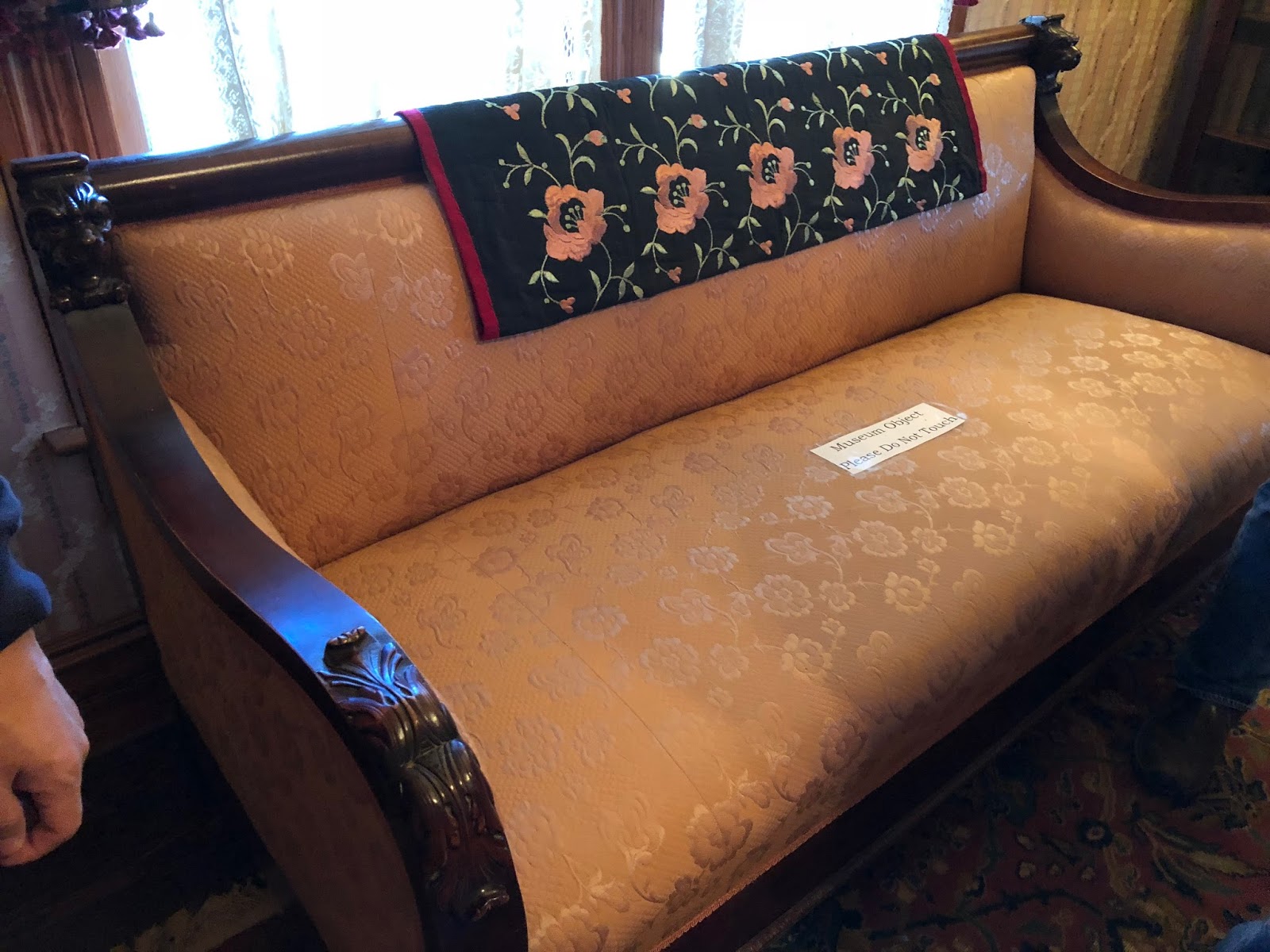
This beautiful settee with its floral pattern and ornately carved arms sits right against the northern wall.


Looking back over our shoulder (toward the entry way), we can get a good look at the transoms above the doors. A built-in pole lifts the window up and open (or down and closed). This allowed cool air to circulate (which is vital during the hot Texas months). You can also see the yellow patterned wallpaper better in this view.


An interesting pre and post visit worksheet provided by the museum to make you think about the things you will see: www.heritagefarmstead.org/wp-content/uploads/2012/07/Farrell-Wilson-House.pdf

Learn more by checking out the official site - www.heritagefarmstead.org/

Heritage Farmstead Museum Physical Address: 1900 West 15th Street, Plano, Texas 75075 Phone Number: 972-881-0140 Hours: Tuesday-Sunday: 10am-4:30pm. Closed Mondays and major holidays. Admission: $3.00 per person (ages 3 and up) + $4 for tour of house

Photo Credit of Formal Parlor - https://heritagefarmstead.org/wp-content/uploads/2012/07/Formal-Parlor-213.jpg

Historical Tidbit Thursdays - The Oregon Trail - The Beginnings - #TidbitThursday

Howdy!

Welcome to our newest addition to the blog - Historical Tidbit Thursdays!

The next few weeks I'm veering off my normal Texas History research trail to dive deep into the Oregon Trail and share my research with you! Hope you enjoy!


In 1824, Jedediah Smith, a mountain man, found a pass through the Rocky Mountain, thus opening a way to travel to the Oregon Country.

In 1836, the White Mission was established in a place near today's Walla Walla, Washington. It became a stop near the end of what would become the Oregon Trail.

Up until this time, Oregon Country had passed many hands - Spain, Great Britain, Russia, and France - until Great Britain finally obtained control of it.

In 1846, a treaty was signed giving the United States part of the Oregon Territory.

In 1843, the first large group of 1000 emigrants left Independence, Missouri for Oregon Territory. They journeyed for 6 months over 2000 miles with 120 wagons pulled by oxen.

Source:
How Many People Traveled the Oregon Trail? by Miriam Aronin; ISBN#978-0-7613-5332-4


Photo Credit: https://en.wikipedia.org/wiki/Jedediah_Smith#/media/File:Jedediah_Smith.jpg

Historical Tidbit Thursdays - The Oregon Trail - The Beginnings - #TidbitThursday

Howdy!

Welcome to our newest addition to the blog - Historical Tidbit Thursdays!

The next few weeks I'm veering off my normal Texas History research trail to dive deep into the Oregon Trail and share my research with you! Hope you enjoy!

In 1824, Jedediah Smith, a mountain man, found a pass through the Rocky Mountains. He and his companions were the first U.S. explorers to reach Oregon country.

In 1836, the White Mission was founded at what is today's Walla Walla, Washington; it became a stop near the end of the Oregon Trail.

Mountain men and fur trappers journeyed to Oregon Country over the years. The first large group to travel over what would become known as the Oregon trail left Independence, Missouri in May of 1843. 1000 people made the 2000 mile journey over 6 months with 120 wagons.

The Oregon Country had changed hands many times before this time among France, Russia, Great Britain and Spain. By 1846, a treaty with Great Britain made it a part of the United States.

Source:
The Oregon Trail by Rachel Lynette; ISBN#978-1-4777-0786-9 ISBN#0-306-80586-3

Western Word of the Week - Opera House - #WesternWordoftheWeek

Howdy!

Welcome to our Weekly Western Word of the Day...

Opera House or Op'ra House - top rail of the main corral

Also used as "Watchin' the op'ra" or "Ridin' the fence"

Source:
Cowboy Lingo by Ramon F. Adams; ISBN#0-618-08349-9

Western Travel - Heritage Farmstead Museum (Part Two) - Plano, Texas - #TravelTuesday

Welcome to my weekly column #TravelTuesday featuring places I've discovered during my research trips or just wandering around in historical areas. I hope you enjoy my discoveries.

Last week we started our tour of the Heritage Farmstead Museum in Plano, Texas. Today we'll get a closer look at the Farrell-Wilson house...

The Farrell-Wilson house was built in 1891 and is a beautiful example of late Victorian "shingle-end" architecture. The colorful paints closely match those that would have been used during that time. This home is a real showplace with jigsaw trim and wrap-around porch.


In the 1900's, a fenced flower bed was a sign of wealth, as the lady of the house (or her servants) had time to maintain a garden that only functioned for beauty. With the rise of the middle class and the growing interest in ladies' magazines, leisure gardening grew popular. Some key gardening features included ornamental fences, seating, front and back lawns, garden decor or urns, trellises, etc.


Cedar trees in the front yard might have been planted to celebrate special occasions such as a marriage or a baby's birth since these trees were considered lucky.


This well-preserved house has earned many coveted designations - a State of Texas Historical marker, a listing in the National Register of Historic Places, and accreditation from the prestigious American Association of Museums.


Some inviting rocking chairs rest on the porch. Next week we'll step inside the house...


A nice article highlighting the efforts to bring the Victorian garden back to its former glory (as best they could): www.ccmgatx.org/community-service/heritage-farmstead-victorian-garden.aspx
Interested in Victorian Gardens? Check out this article - www.victoriana.com/gardening/victoriangarden.html

Learn more by checking out the office site - www.heritagefarmstead.org/

Heritage Farmstead Museum Physical Address: 1900 West 15th Street, Plano, Texas 75075 Phone Number: 972-881-0140 Hours: Tuesday-Sunday: 10am-4:30pm. Closed Mondays and major holidays. Admission: $3.00 per person (ages 3 and up) + $4 for tour of house